
From The Knot and Zola to Pearl’s emerging AI-powered marketplace, wedding professionals have more questions than ever about advertising value. Industry interviews reveal where directories can deliver opportunities, why some businesses struggle and how to determine whether a paid listing makes financial sense.
Wedding directories have been connecting engaged couples with wedding professionals for decades. For venues, photographers, florists, caterers and other businesses, these platforms can offer something that is difficult to build independently: access to a large audience of couples actively planning weddings.
That access can be valuable, particularly for businesses looking to reach couples beyond their existing referral networks.
But purchasing a listing does not automatically produce bookings.
A wedding professional might receive a steady stream of inquiries without converting many into paying customers. Another business might receive fewer inquiries but book enough weddings to make the investment worthwhile.
And in some markets, businesses may discover that the cost of competing for attention outweighs the return.
So how does a wedding professional know whether a directory is helping grow their business—or whether it’s time to invest elsewhere?
Interviews conducted by Wedding Market News with wedding professionals and venue consultant Lorie Speich reveal why the answer depends on much more than the number of leads a platform delivers.
Why Wedding Directories Can Be Valuable
One of the greatest advantages of a wedding directory is access to couples who are already researching wedding services.
Unlike advertising that interrupts someone who may have no immediate need for a wedding professional, a directory attracts people who are actively comparing venues, photographers, planners and other vendors.
That creates an opportunity to reach potential customers closer to a purchasing decision.
Directories can also provide visibility beyond a business’s own website or social media audience.
For a newer wedding professional without an established referral network, appearing alongside other businesses in a recognized marketplace can introduce the company to couples who might never otherwise discover it.
Reviews, photographs, business descriptions and inquiry tools can help couples compare options in one location.
Wedding directories are more than advertising listings. They are marketplaces built around helping couples research and plan weddings.
A directory can provide a meaningful source of business when its audience, geographic reach and advertising opportunities align with a vendor’s needs.
The key is understanding what that access is worth to the individual business.
Does Paying More Mean Getting Seen More?
Visibility is one of the most important considerations when evaluating directory advertising.
A directory may attract thousands of couples, but that doesn’t mean every business listed receives equal exposure.
Prominent placement in online marketplaces can influence how easily consumers discover a business, much like paid placement in Google Search.
Businesses appearing near the top of search results may attract more attention than those appearing farther down the page.
Lorie Speich, co-creator of Visit the Venues, discussed the relationship between advertising expenditures and visibility, including her observations about how paid participation can influence opportunities for wedding professionals.
Paying for better placement can be a legitimate marketing strategy.
But greater visibility does not guarantee more inquiries or bookings.
Getting seen is only the first step. What couples see when they discover your business—including your photos, videos and customer reviews—can be just as important.
Weddings are highly visual, and compelling photographs and videos are the eye candy that captures attention and encourages couples to explore a listing. But reviews also play an important role in that first impression.
Couples aren’t simply looking at beautiful images. They’re evaluating whether a business is experienced, reliable and capable of delivering what it promises.
A strong portfolio may attract a couple’s attention, while positive reviews can provide the confidence needed to make an inquiry.
For venues, this may mean showcasing ceremony spaces, beautifully designed receptions, real weddings and videos that capture the atmosphere and guest experience.
For photographers, it means selecting images that demonstrate creativity, emotion and storytelling rather than simply displaying a large collection of photographs.
Florists, planners, culinary professionals and other wedding businesses need visuals that communicate the quality, style and value of their services.
Video can help couples imagine what it would be like to experience a venue or work with a particular business.
A compelling opening image may persuade a couple to click on a listing. Less engaging content may cause them to continue scrolling.
For newer wedding professionals, this combination of visuals and reviews is especially important.
A business with only a handful of reviews may be competing against established companies with dozens or even hundreds. Strong photography and video can help demonstrate the quality of its work, while authentic customer reviews build credibility.
Paid placement can help couples discover your business. Photos and videos capture their interest. Reviews help establish trust. Together, these elements can turn visibility into inquiries and ultimately help generate bookings.
Before paying for greater exposure, wedding professionals should evaluate whether their listings are strong enough to make the most of that opportunity.
Your Local Market May Determine Whether Advertising Works
A directory that performs well for one business may produce disappointing results for another—even when both purchase similar advertising packages.
Geographic competition is a major factor.
Consider a new wedding photographer with eight reviews competing against established photographers with 50 or 100 reviews.
The newer business may offer excellent services, but couples comparing listings may gravitate toward companies with more extensive portfolios and established reputations.
Paid placement can improve visibility, but it may not eliminate that competitive disadvantage.
The same challenge applies to wedding venues, planners and other categories.
A venue in a smaller market with limited competition may have a better opportunity to stand out than a venue competing against dozens of established properties in a large metropolitan area.
This is why wedding professionals should evaluate their specific category and city rather than relying solely on a platform’s national audience figures.
Before investing, examine how many businesses are competing for attention, how their listings are presented, what reviews they have and whether your own business offers a compelling reason for couples to choose it.
A directory can be a valuable investment in one market and a poor fit in another.
Are the Leads Worth What You’re Paying?
Lead volume is one of the most frequently discussed measures of directory performance.
But not all inquiries are equal.
During interviews with Wedding Market News, both Speich and a wedding professional in the culinary sector discussed their experiences and observations involving leads from The Knot.
Their accounts illustrate why businesses need to look beyond the number of inquiries they receive.
A couple might be genuinely interested in wedding services but lack a confirmed date, an established budget or a clear understanding of what they need.
Other couples may contact several businesses and never respond to follow-up messages.
An inquiry is an opportunity to begin a sales conversation—not a guaranteed booking.
For wedding professionals, the more meaningful measurements are how many inquiries turn into conversations, consultations and ultimately paying customers.
Consider two hypothetical advertising investments.
One directory produces 30 inquiries and one booking.
Another marketing channel produces 10 inquiries and five bookings.
The first may appear more successful when measured by lead volume, but the second produces substantially more sales.
Businesses should also consider the value of each booking.
One profitable wedding could justify an advertising investment that generated relatively few inquiries. Conversely, dozens of inquiries may not justify the cost if none becomes profitable business.
The question should not simply be, “How many leads did I receive?”
It should be, “How much profitable business did this advertising help generate?”
The Time Required to Maintain a Listing
Advertising expenses don’t end with the monthly or annual listing fee.
A wedding professional interviewed by Wedding Market News described the work involved in maintaining a directory presence while managing a business built around customized services.
The professional, who works in the culinary sector, explained that requests for standardized wedding packages and pricing did not accurately reflect the way the business operates.
The professional also questioned pricing information displayed on the listing that was not recognized.
This raises two important considerations.
First, a directory needs to represent a business accurately. Standardized pricing and package structures may work well for some companies but not for businesses that create individualized proposals.
Second, maintaining a successful listing takes time.
Photographs and videos need updating. Descriptions must remain accurate. Inquiries require prompt responses. Reviews and business information need attention.
For a small business owner already balancing client meetings, production and events, those responsibilities can become substantial.
That time has value.
When calculating return on investment, wedding professionals should consider both their advertising fees and the hours required to maintain the platform.
A listing that produces bookings may still be worthwhile, but its true cost should be understood.
When the Problem Isn’t the Directory
Not every disappointing advertising result can be attributed to the platform.
Some businesses receive legitimate inquiries but struggle to convert them into bookings.
Speich shared an example involving a wedding venue that conducted eight tours during one weekend without booking a single wedding.
After observing the venue’s sales approach and helping improve the process, she reported that six bookings resulted from tours the following weekend.
The example illustrates the difference between generating opportunities and converting them.
The venue was attracting interested couples. The challenge involved what happened during the sales process.
For wedding professionals, the ability to respond promptly, ask meaningful questions, explain their value and guide couples toward a decision can have a substantial effect on advertising performance.
This is also where ghosting enters the conversation.
In March 2014, Wedding Market News hosted a #WeddingMarket Chat with wedding industry sales expert and former Knot executive Alan Berg about improving email conversations with prospective couples.
Berg emphasized personalized communication and the importance of following up rather than abandoning an inquiry after one unanswered message.
His advice remains relevant.
Couples may be contacting multiple businesses, comparing prices or changing their plans.
A couple who stops responding is not necessarily a fake lead.
Before concluding that a directory isn’t working, businesses should examine how quickly they respond, how they communicate and whether their sales process is helping interested couples take the next step.
Read the original Wedding Market News interview: How to Improve Email Conversation with Alan Berg.
When Lead Quality Becomes a Legitimate Concern
Although poor conversion isn’t always the directory’s fault, wedding professionals also have legitimate reasons to question the quality of advertising leads.
One important factor often overlooked in discussions about wedding directories is the presence of bad actors.
Fraudulent inquiries, bots, spam accounts and inaccurate contact information are problems throughout the digital advertising industry. They affect platforms such as Facebook and Google, as well as business websites, email marketing campaigns and online marketplaces.
Wedding directories are not immune.
When an online platform allows people to create accounts or submit inquiries, it can attract individuals or automated systems that provide false information, send unsolicited messages or engage in other deceptive activity.
Some questionable leads may originate from outside actors rather than from the advertising platform itself.
That distinction matters.
A business receiving a suspicious inquiry may understandably question the quality of the leads it is purchasing. But the presence of a fraudulent inquiry does not automatically establish that the platform created it, knowingly distributed it or engaged in deceptive advertising practices.
Even sophisticated technology cannot eliminate every fraudulent submission.
Artificial intelligence, automated bot detection, account verification and other security measures can help identify suspicious activity, but no system is perfect.
The challenge for wedding directories—and digital advertising platforms generally—is determining how effectively they identify questionable activity, protect advertisers and respond when problems are reported.
What The Knot Says About Spam and Bad Actors
The Knot Worldwide has publicly addressed concerns about questionable leads.
In an April 2025 statement published through WeddingPro, the company acknowledged that outside actors sometimes misuse its platform.
According to The Knot Worldwide, fewer than 1% of leads on its platform were marked as spam by vendors in 2024.
The distinction is important. That figure represents leads identified as spam by vendors, not necessarily the total percentage of fraudulent, inaccurate or otherwise questionable inquiries.
The company also identified three factors that may contribute to concerns about fake leads: automated message templates used by couples, inquiries that receive no follow-up response and spam originating from outside actors.
The Knot stated that it was increasing investment in spam detection and prevention, while also developing tools intended to improve communication between couples and wedding professionals.
These explanations provide additional context for advertisers evaluating lead quality.
The presence of spam does not necessarily indicate wrongdoing by a directory. However, how a platform prevents suspicious activity, addresses complaints and communicates with advertisers remains an important part of evaluating its service.
Source: The Knot Worldwide, “You Spoke, We’re Taking Action: Supporting Your Success,” April 2025.
A Personal Experience With Inaccurate Lead Information
I experienced a different form of inaccurate lead information in 2009, when I purchased a geographically targeted mailing list through The Knot for my wedding business.
The campaign generated some legitimate leads, but at least 100 pieces of mail were returned as undeliverable.
I had paid for the mailing information, printing and postage.
After I raised my concerns, The Knot provided additional advertising-related items as compensation rather than a monetary refund.
That experience involved a different advertising product and occurred long before today’s complaints.
Nevertheless, it demonstrates why the accuracy of information matters to advertisers.
An undeliverable address does not establish intentional wrongdoing, just as an unanswered online inquiry does not automatically mean a lead was fraudulent.
But when businesses pay for access to prospective customers, they reasonably expect platforms to take steps to maintain the quality and accuracy of the information being provided.
What Responsibility Does the Directory Have?
Wedding professionals should recognize that no advertising platform can guarantee every lead will be legitimate, qualified or ready to book.
At the same time, directories should have reasonable systems for identifying suspicious activity and addressing complaints.
That may include automated fraud detection, account verification, human review and processes for reporting or disputing demonstrably invalid inquiries.
Transparency is particularly important.
Advertisers should understand how leads are generated, what protections are in place and what options are available when questionable activity occurs.
The presence of bad actors does not automatically mean a wedding directory is operating improperly. But how a platform identifies and responds to those bad actors can be an important measure of its value to advertisers.
Ultimately, wedding professionals need to distinguish among three very different situations: a fraudulent inquiry, a legitimate couple who stops responding and a qualified lead that does not become a booking.
Each situation requires a different response—and only some are within the advertising platform’s control.
The FTC Complaints: Why Advertising Transparency Matters
Questions about The Knot’s advertising practices have reached federal officials.
Senator Chuck Grassley of Iowa has repeatedly asked the Federal Trade Commission to examine allegations involving advertising contracts, paid placement, billing and lead quality.
His correspondence, beginning in March 2025 and continuing through subsequent letters, describes concerns raised by wedding professionals.
Some advertisers have alleged that they did not receive the placement or advertising value they expected. Others have questioned lead legitimacy or contract and billing practices.
These allegations are not established findings of wrongdoing.
The FTC has not publicly confirmed whether a nonpublic investigation exists, and that uncertainty should not be represented as evidence of misconduct.
The Knot has disputed allegations of wrongdoing.
For wedding professionals considering any directory—not just The Knot—the larger lesson is to understand the advertising agreement before signing.
What placement is promised? What services are included? How are inquiries generated? What happens if there is a billing dispute or a demonstrably invalid lead?
And what commitments will the business have if the advertising doesn’t produce the expected results?
Transparency helps advertisers make informed decisions.
The Knot, Zola and Pearl: How the Marketplace Is Changing
Wedding professionals are also facing changes in the companies competing for their advertising budgets.
On October 14, 2026, The Knot Worldwide announced an agreement to acquire Zola.
The proposed transaction would bring two major wedding planning platforms under common ownership, although the brands are expected to remain separate consumer-facing services.
The transaction remains subject to closing conditions and any required approvals.
Speich expressed concern about the potential for reduced competition and greater pricing influence if the acquisition is completed.
For wedding businesses, having independent advertising options can be valuable because it allows them to compare prices, audiences and results.
At the same time, larger platforms may be able to invest in technology and services that benefit users and advertisers.
Another competitor is emerging through David’s Bridal.
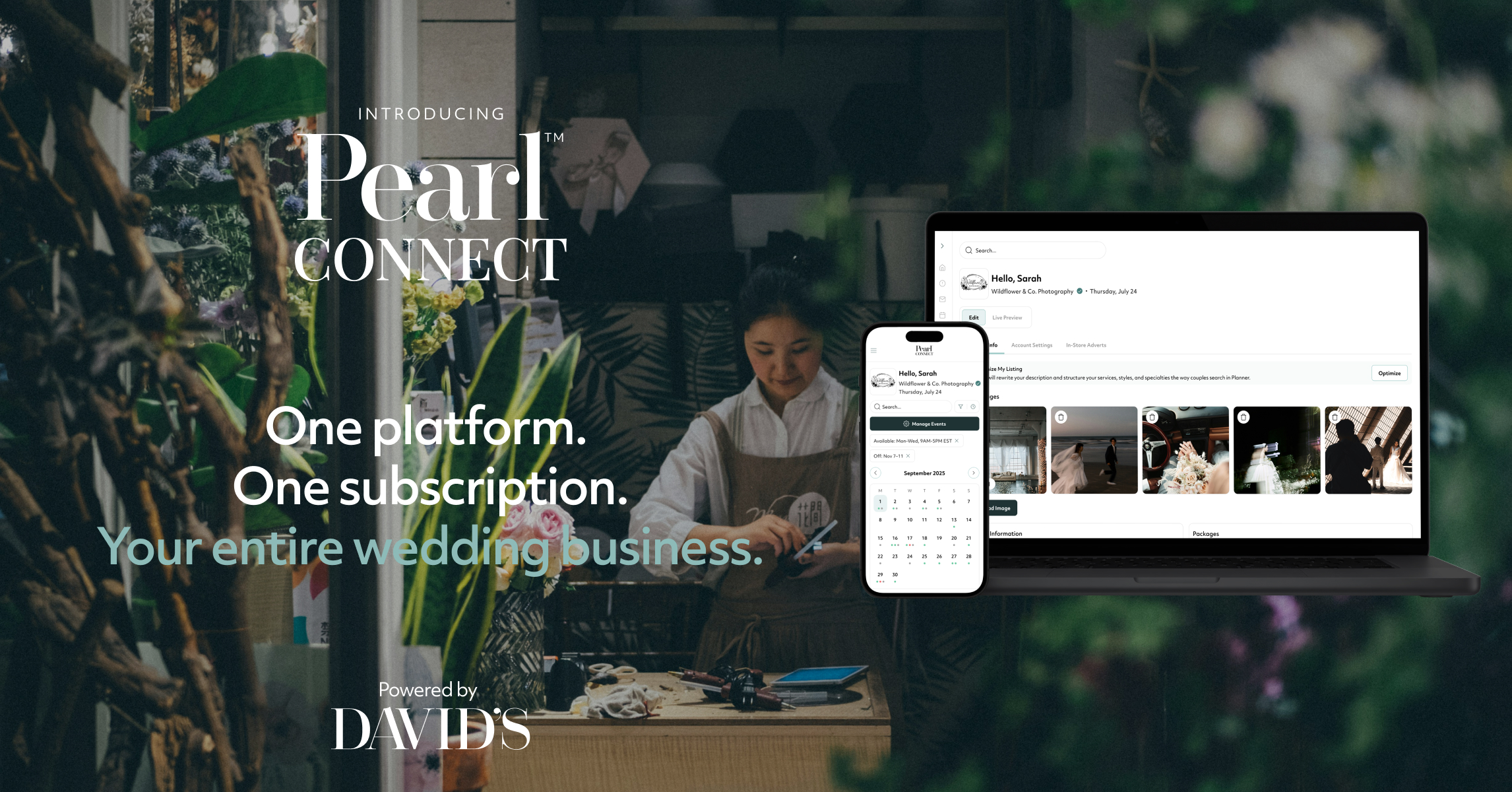
Pearl Connect, powered by David’s, brings wedding business tools into a single platform and subscription for wedding professionals.
In September 2026, the company introduced Pearl Connect, an AI-powered platform designed to connect wedding professionals with couples and provide business tools for communication, appointments and bookings.
Pearl offers paid features, including priority placement.
Wedding Market News contacted Pearl to ask whether it had tested the platform with wedding professionals before its national launch and whether its leads were converting at higher rates than those generated by traditional directories.
Regarding its pilot program, Pearl stated:
“The quantitative results, combined with positive feedback from participants, validated our strategy and the value we offer, giving us the confidence to launch and scale the program nationally.”
The company said its beta test included professionals in photography, videography, content creation, florals, catering, venues, planning and styling.
However, when Wedding Market News asked whether Pearl had conversion data comparing its leads with those from traditional wedding directories, the company responded:
“Pearl Connect is still in its early stages following last month’s launch, and we don’t have metrics we’re disclosing at this time.”
Pearl added that it is continuing to track performance and would be willing to share updates as additional data becomes available.
For wedding professionals considering a new advertising platform, that distinction matters.
Pearl reports encouraging early results, but without publicly disclosed comparative conversion data, advertisers cannot yet evaluate whether its AI-powered approach generates more bookings than traditional wedding directories.
New technology may offer additional opportunities, but it should ultimately be evaluated by the business it produces.
The same standard should apply to every wedding directory, whether it has been operating for decades or has just entered the marketplace: What results can it deliver for your business?
Could AI Change the Value of Wedding Directories?
Traditional wedding directories offer established audiences, reviews and planning resources.
But couples now have additional ways to research businesses, including conversational AI tools.
Rather than scrolling through a long directory, a couple can ask for recommendations based on a location, budget, wedding style or specific service.
That creates opportunities for wedding professionals to be discovered through their own websites, reviews, business information and online content.
It also raises new questions about how AI systems choose which businesses to recommend.
Directories may continue to play an important role, particularly when couples value comparing vendors, viewing portfolios and reading reviews in one place.
How to Know When a Wedding Directory Is Right for You
A paid wedding directory may be a worthwhile investment when it consistently reaches couples in your target market and produces enough profitable bookings to justify its cost.
It may be especially valuable when your business has strong photography and video, positive reviews, a compelling listing and a reliable process for responding to inquiries.
But there are warning signs that deserve attention.
If your market is saturated with established competitors, the cost of achieving meaningful visibility may outweigh the potential return, making paid directory advertising an investment that simply isn’t worthwhile for your business.
If you receive numerous inquiries but very few qualified consultations, examine both lead quality and your communication process.
If the platform requires substantial maintenance without producing measurable results, consider whether that time could be invested more productively elsewhere.
And if your services cannot be accurately represented through the platform’s listing structure, that limitation may affect the types of couples who contact you.
Before renewing a contract, review your actual results rather than relying on the total number of inquiries reported.
Calculate the advertising cost, account for the time involved, and compare the revenue and profit generated with other marketing channels.
A directory doesn’t need to produce the most leads to be worthwhile.
It needs to produce enough valuable business to justify the investment.
When It May Be Time to Walk Away
Deciding not to advertise on a wedding directory is not necessarily a criticism of the platform.
It may simply mean the platform is no longer the best marketing investment for your business.
A company that once relied heavily on directory leads may eventually develop a strong referral network and organic search presence.
Another business may discover that local partnerships, social media, wedding shows or direct website inquiries produce more profitable customers.
Some businesses may find that a directory performs well during their early years but becomes less important as their reputation grows.
Others may benefit from maintaining a presence on a platform while reducing or eliminating paid advertising.
The decision should be based on the individual business’s goals, market conditions, financial results and available alternatives.
Before leaving, however, examine whether improvements to your listing, photographs, videos, reviews, follow-up or sales process could change the outcome.
If the numbers still don’t justify the investment, it may be time to redirect the budget.
The Bottom Line: A Directory Is a Marketing Tool, Not a Business Strategy
Wedding directories can be valuable.
They can introduce businesses to engaged couples, expand visibility beyond existing networks and generate opportunities that might otherwise be difficult to obtain.
Well-established wedding marketplaces can offer meaningful exposure to couples who are actively searching for wedding services.
At the same time, the experiences shared by wedding professionals illustrate why results can vary considerably.
Competition, reviews, paid placement, lead quality, the time required to maintain listings and a business’s sales process all influence the outcome.
The proposed Knot-Zola acquisition, Pearl’s introduction of AI-powered discovery and federal concerns about advertising transparency make this an important time for wedding professionals to evaluate their marketing investments.
But the central question remains practical.
Is the directory helping your business grow profitably?
Visibility gets a wedding business discovered. The right photos and videos capture attention. Reviews build trust. Communication creates relationships. And a strong sales process turns qualified inquiries into bookings.
No directory can replace all of those elements.
For some wedding professionals, paid listings will remain an important part of their marketing strategy.
For others, the best decision may be to improve their presence, reduce their spending or invest in different channels.
The best advertising platform isn’t necessarily the biggest or the newest. It’s the one that delivers the right opportunities at a cost your business can sustain.
Wedding Market News continues examining the changing wedding marketplace, including directory advertising, the proposed Knot-Zola acquisition, AI-powered vendor discovery and the experiences of wedding professionals.
Join the conversation: Has a wedding directory been a worthwhile investment for your business? What helped you determine whether to continue advertising—or spend your marketing budget elsewhere?