
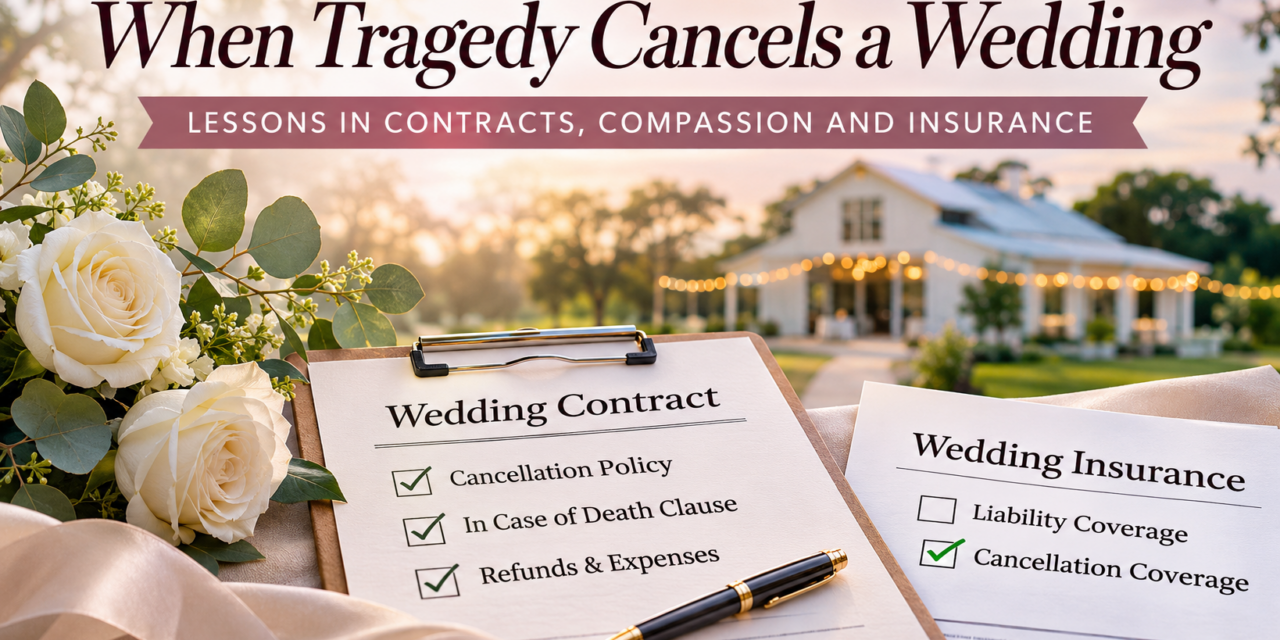
Following the resolution of a wedding venue dispute involving the death of a groom, two industry experts offer guidance on cancellation policies, insurance coverage and protecting a wedding business’s reputation.
A wedding that was supposed to celebrate the beginning of a marriage instead became the center of a public dispute after the groom unexpectedly passed away.
The disagreement involving Posey Meadows, a Texas wedding venue, and the family of the late groom, Diego, attracted attention over the issue of nonrefundable wedding payments.
The dispute has since been resolved.
Attorney Manny Pelaez-Prada provided Wedding Market News with the following statement:
“I’m happy to report that, at the end of the day, Posey Meadows helped us reach a resolution of the dispute that is fair to all involved. Zoe and Diego’s parents are all very grateful to everyone who shared their thoughts and prayers with the family. We hope everyone will join them in focusing on what matters most — honoring Diego’s memory.”
Pelaez-Prada emphasized that he could not discuss the case, its facts or the parties involved. However, he offered general recommendations for wedding venues that may face similar circumstances in the future.
Wedding Market News also spoke with Bryan Krug, Business Development and Program Manager at JM Insurance Agency Partners, Inc., about the importance of wedding cancellation insurance and why couples may not have the protection they believe they purchased.
Together, their perspectives highlight several issues wedding professionals should consider before an unexpected cancellation occurs.
Should Wedding Contracts Address the Death of a Bride or Groom?
Wedding venues rely on contracts to protect their businesses against financial losses when events are canceled.
Deposits and cancellation provisions can help offset lost bookings, committed expenses and other costs.
However, attorney Manny Pelaez-Prada recommends that venues consider specific contract language addressing the death of a bride or groom rather than treating such circumstances as an ordinary cancellation.
His suggested provision would allow a surviving partner or legally authorized representative to cancel the agreement by providing written notice.
It would also eliminate additional payments and cancellation fees while allowing the venue to retain a limited amount for documented, nonrecoverable expenses.
Under his proposed language, a venue could retain the lesser of its reasonable, documented, nonrecoverable costs or 10% of the total amount already paid.
This is proposed contractual language rather than a legal requirement. Wedding businesses should consult their own attorneys before incorporating similar provisions.
A clearly written policy could help both businesses and families understand what happens financially if an unexpected death prevents a wedding from taking place.
How Should Venues Communicate With Grieving Families?
Pelaez-Prada believes wedding businesses should establish procedures for responding to families experiencing a crisis before an emergency occurs.
He says requesting proof of death is reasonable, but venues should understand that obtaining documentation may take weeks or months.
Businesses should explain why documentation is necessary and allow families reasonable time to provide it.
He also recommends designating one individual, preferably the venue owner, to communicate with the family.
This can prevent grieving relatives from repeatedly explaining traumatic circumstances to multiple employees.
Venue staff should know who has the authority to make decisions and when families can expect a response.
Before determining whether payments can be returned, Pelaez-Prada advises venues to review their actual expenses and consider whether the canceled date can be rebooked.
If the venue retains money, it should clearly explain what those funds cover.
He also encourages businesses to consider how other wedding vendors are handling the cancellation and whether retaining a payment is appropriate under the circumstances.
Most importantly, he urges wedding professionals to recognize the emotional circumstances surrounding these conversations.
“Never forget that compassion should always inform your decisions when dealing with vulnerable people.”
His recommendation is to approach grieving families with patience, flexibility and kindness rather than relying exclusively on contractual language.
Wedding Insurance: Liability Versus Cancellation Coverage
One of the most important financial considerations for wedding professionals is whether couples understand the different types of wedding insurance.
Bryan Krug, Business Development and Program Manager at JM Insurance Agency Partners, Inc., which offers the Event Guard wedding and event insurance program, told Wedding Market News that many couples purchase insurance without fully understanding what is covered.
Wedding insurance generally includes two types of protection.
Liability insurance provides coverage for certain accidents, injuries and property damage associated with an event, subject to policy terms.
Cancellation insurance may reimburse eligible nonrefundable expenses when a wedding cannot proceed because of specified unforeseen circumstances.
Depending on the policy, covered reasons may include serious illness, accidents or the death of a bride or groom.
Krug, who previously spent 10 years working as a claims adjuster, said many venues require couples to purchase liability insurance but do not require cancellation protection.
As a result, couples may satisfy their venue’s insurance requirements without protecting the money they have invested in the wedding.
Krug estimated that approximately 30% of couples purchase wedding insurance, and roughly 75% of those insured couples purchase liability coverage without cancellation protection.
These percentages reflect his estimates rather than independently verified industry-wide statistics.
He also described handling claims involving unexpected accidents and serious illnesses that prevented weddings from taking place.
The important distinction is that liability coverage generally protects against covered third-party claims, while cancellation coverage addresses certain financial losses associated with an event that cannot proceed.
Coverage for any particular cancellation depends on the policy’s terms, exclusions and other conditions.
Should Wedding Venues Require Cancellation Insurance?
Pelaez-Prada recommends that venues require couples to purchase wedding insurance within a week of signing their contracts and provide proof that the coverage was purchased.
He also suggests maintaining a list of three insurance providers so couples can obtain coverage quickly.
Krug’s perspective adds another consideration: What type of insurance are couples actually purchasing?
Many venues require liability insurance because it can help protect the business if an accident occurs during an event.
But liability insurance does not ordinarily reimburse couples for nonrefundable deposits when a wedding must be canceled.
Cancellation coverage serves a different purpose.
Wedding professionals may want to educate couples about both types of protection rather than assuming that a general insurance requirement addresses every financial risk.
For example, couples making substantial nonrefundable payments could benefit from understanding whether cancellation coverage is available and what circumstances qualify.
Venues may also want to consider whether recommending or requiring cancellation coverage could help reduce financial disputes when unforeseen events prevent weddings from taking place.
Insurance is not a guarantee that every cancellation will be covered, and coverage limits, exclusions and policy conditions must be reviewed carefully.
When Keeping a Deposit Could Cost More Than Refunding It
Beyond contracts and insurance, Pelaez-Prada raises another important consideration for wedding businesses: protecting their reputations.
Wedding venues invest years building relationships, attracting referrals and establishing their brands.
A contract may legally permit a business to retain a deposit following a cancellation, but the decision can have consequences beyond the immediate financial transaction.
“Your contract might be perfect and may withstand any lawsuit, but will it withstand one-star reviews and a campaign of mean spirited comments on social media?”
Pelaez-Prada encourages venues to evaluate whether enforcing a nonrefundable payment provision is worth the potential damage to their reputation and future business.
He suggests that flexibility, including returning some or all of a deposit when appropriate, can sometimes be a better long-term business decision.
This does not mean wedding businesses should disregard their financial obligations or automatically refund every cancellation.
Rather, it means considering the circumstances, documenting actual losses and balancing contractual rights with compassion and long-term customer relationships.
Preparing Before a Crisis Happens
For wedding venues and other wedding professionals, the most valuable lesson may be the importance of having clear policies before an unexpected cancellation occurs.
Businesses can review their contracts to determine whether they adequately address death-related cancellations and other extraordinary circumstances.
They can establish procedures for communicating with families, documenting expenses, evaluating refund requests and making timely decisions.
Wedding planners and venues can also help couples understand the difference between liability and cancellation insurance before substantial deposits are paid.
A well-written contract provides financial clarity. Appropriate insurance can help protect against certain unforeseen losses. Compassionate communication can preserve trust during difficult circumstances.
Together, these measures may help wedding businesses navigate situations that no couple or professional ever wants to experience.
For the family involved in the Posey Meadows dispute, the matter has reached a resolution, and the attorney’s statement asks that attention now turn toward honoring Diego’s memory.
For the broader wedding industry, the discussion presents an opportunity to reconsider how businesses prepare for extraordinary circumstances.
Are wedding professionals doing enough to protect both their businesses and the couples who trust them with one of life’s most important celebrations?


