Colin Cowie on the Future of Weddings: Why Personalization Matters More Than Tradition
After four decades of designing extraordinary celebrations, Colin Cowie discusses how artificial intelligence, changing traditions and a renewed emphasis on guest experiences are shaping the future of weddings.
For decades, weddings followed a familiar formula. Ceremonies, cocktail hours, formal dinners, speeches and dancing were arranged around traditions that had been passed down through generations.
But today’s couples are increasingly interested in creating celebrations that reflect their personalities, relationships and individual styles.
Few wedding professionals have witnessed the evolution of the industry quite like Colin Cowie.
Celebrating 40 years in event design in 2026, Cowie has created elaborate celebrations for high-profile clients while developing an approach to entertaining that emphasizes hospitality, atmosphere and memorable experiences.
In an exclusive interview with Wedding Market News, Cowie discussed how wedding traditions are evolving, why guest experiences deserve greater attention and how artificial intelligence is transforming the creative process.
His perspective suggests that the future of weddings may be less about following the latest trends and more about creating celebrations that are unmistakably personal.
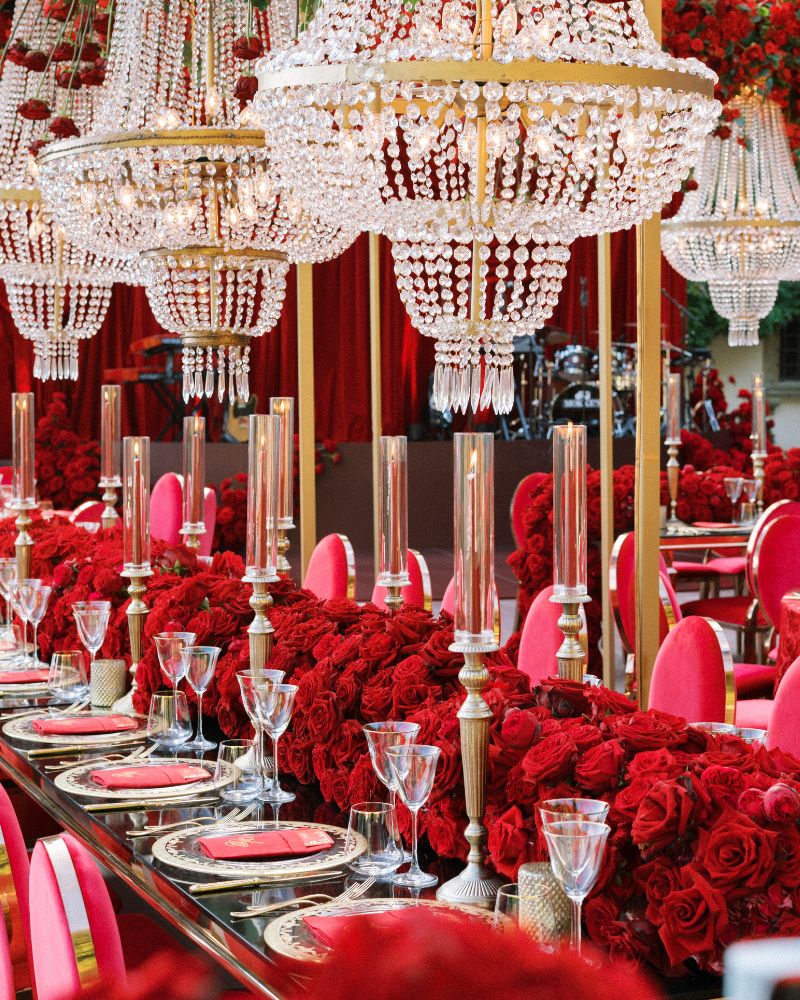
An immersive reception design by Colin Cowie combines cascading crystal chandeliers, suspended red roses and elaborate floral tablescapes. Photography: Jose Villa .
Moving Beyond Wedding Traditions
For generations, wedding planning has involved decisions shaped by established customs. Brides wore white, guests followed conventional dress codes, receptions followed familiar schedules and couples often selected decorations based on what was fashionable.
Today, couples have more freedom to redefine those expectations.
Cowie discussed the importance of couples making a “joint statement of style” through their celebrations.
That expression can extend well beyond floral arrangements and table settings. Fashion, entertainment, cuisine, lighting and even the sequence of events can reflect a couple’s identity.
Rather than selecting elements simply because they are considered traditional, couples can consider what each decision communicates about their relationship.
For wedding professionals, this creates opportunities to approach design differently.
Instead of beginning with a predetermined wedding style, planners and designers can begin by learning more about the couple, their interests and the experiences they want to share with family and friends.
The result may be a celebration that doesn’t fit neatly into any established wedding category.
When Wedding Guests Become Part of the Design
One increasingly visible expression of personalization involves guest attire.
Traditionally, guests have been discouraged from wearing white to weddings. But some couples are deliberately moving away from that convention by requesting coordinated colors or specific styles.
Cowie discussed how guest attire can contribute to the overall visual presentation of a celebration.
Rather than asking everyone to wear identical clothing, couples can establish a color palette that allows individual expression while creating a cohesive appearance.
An all-white wedding, for example, can incorporate different shades, fabrics, textures and silhouettes.
The result can be visually striking, particularly when coordinated with the floral design, furnishings and surrounding environment.
However, communicating the dress code becomes especially important.
Cowie discussed how wedding websites can help couples explain their expectations through photographs, mood boards and detailed attire guidance.
This can be particularly valuable for destination weddings, where guests may need to purchase clothing or plan for several different events.
For wedding professionals, coordinated attire also creates an opportunity to think beyond the traditional boundaries of event design.
The guests themselves become part of the visual experience.
The Guest Experience Is More Important Than Ever
While dramatic design can create unforgettable photographs, Cowie’s approach emphasizes something that cannot always be captured in an image: how guests feel during an event.
A wedding may feature extraordinary flowers, elaborate lighting and beautiful furnishings, but those elements alone do not guarantee a memorable experience.
Hospitality, comfort, entertainment and the flow of the celebration all contribute to how guests remember the occasion.
Cowie’s comments suggest that couples and wedding professionals should consider the entire guest journey, beginning with the invitation and continuing through the final moments of the reception.
Are guests comfortable?
Do they understand what is happening throughout the celebration?
Are they spending too much time waiting?
Does the event provide opportunities for meaningful interaction?
These questions can be just as important as choosing a color palette or designing an elaborate centerpiece.
The challenge for wedding professionals is creating an event that looks beautiful while functioning smoothly.
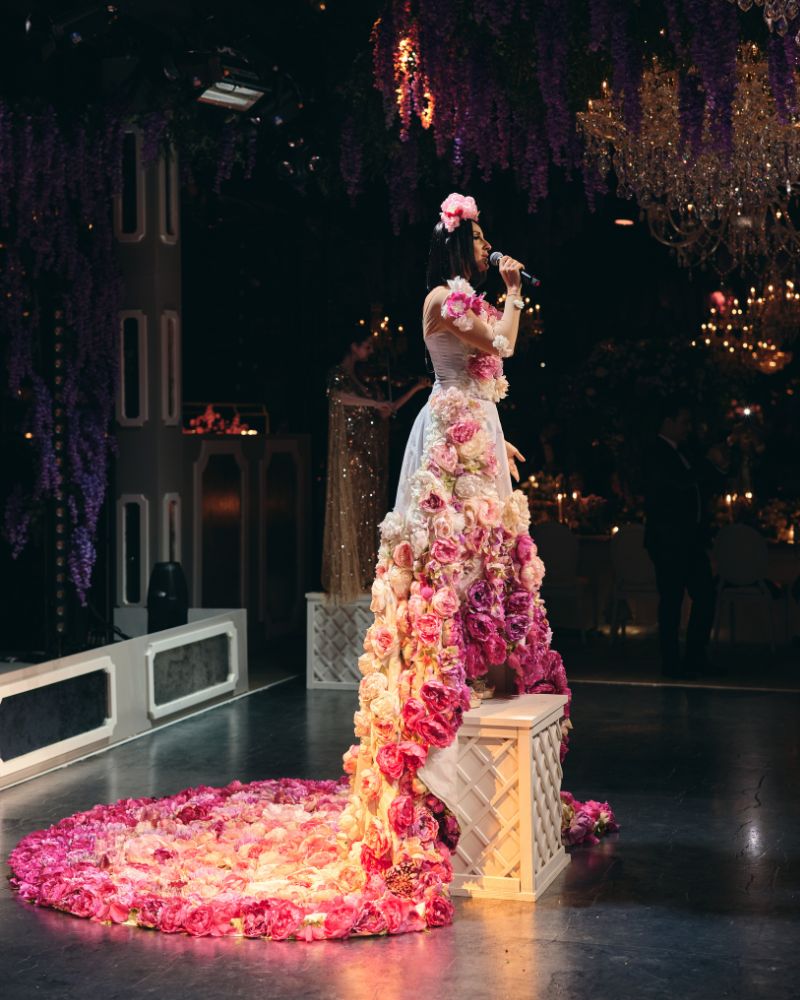
A singer performs in an elaborate pink and purple floral gown beneath cascading flowers and crystal chandeliers, creating an unforgettable wedding entertainment experience. Photo courtesy of Frank Catucci .
Rethinking the Wedding Timeline
One of Cowie’s most practical observations concerned wedding timelines.
Traditional reception schedules can include lengthy cocktail hours, extended dinner service and multiple speeches that delay entertainment.
Cowie favors a more deliberate approach to pacing.
During the interview, he discussed beginning a wedding ceremony within approximately 15 minutes of the stated invitation time.
For cocktail receptions, he suggested approximately 45 minutes, rather than automatically extending the experience to an hour or longer.
He also discussed a dinner service lasting roughly 90 minutes, excluding speeches and toasts.
These recommendations are not rigid rules for every wedding. Rather, they illustrate the importance of considering how guests experience the passage of time.
A cocktail reception that extends too long can leave guests waiting for dinner. A prolonged dinner service can reduce the time available for dancing and entertainment.
And a ceremony that begins significantly later than expected can affect the entire schedule.
For venues, planners, caterers and entertainment professionals, thoughtful coordination is essential.
The objective is not simply to keep an event on schedule. It is to maintain energy, comfort and engagement throughout the celebration.
Artificial Intelligence Is Transforming Wedding Design
Perhaps one of the most significant changes Cowie discussed involves artificial intelligence.
For years, elaborate event renderings required substantial investments of time and money.
Professional designers might spend days or weeks developing visual concepts to help clients understand how an event would look before production began.
Cowie described how artificial intelligence can now dramatically accelerate that process.
During the interview, he compared traditional design renderings that could take one to two weeks and cost approximately $5,000 to $15,000 with AI-generated concepts that can be developed in as little as 15 minutes.
The implications for the wedding industry are substantial.
Planners and designers can use AI to explore different creative directions, experiment with color palettes and help couples visualize ideas before committing to production.
A ballroom might be presented with several different lighting concepts.
A ceremony space could be visualized with alternative floral designs or seating arrangements.
Couples could explore possibilities that might previously have required multiple rounds of expensive renderings.
However, generating an image is only one part of designing a successful event.
An AI rendering may depict elaborate installations, dramatic floral arrangements or architectural features that are difficult or expensive to reproduce.
Professional designers must still evaluate budgets, materials, structural requirements, labor and venue restrictions.
The technology can accelerate the development of ideas, but transforming those ideas into real celebrations requires experience and practical expertise.
For wedding professionals, AI may become an increasingly valuable creative tool rather than a replacement for professional design.
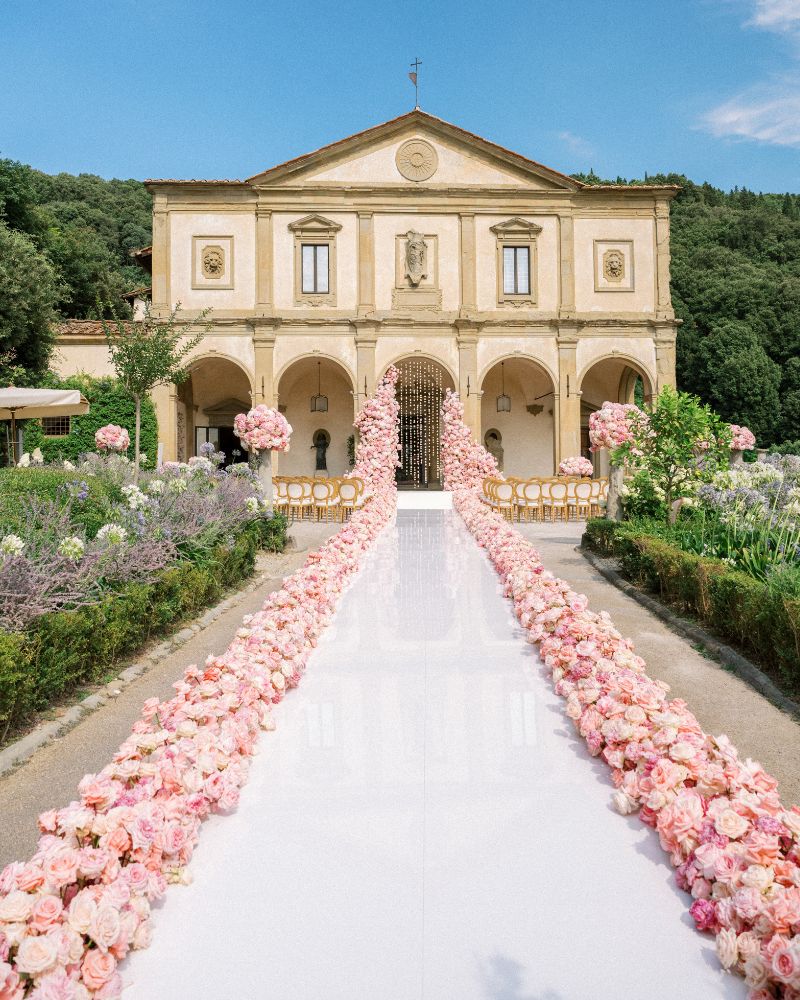
A romantic wedding ceremony designed by Colin Cowie features a white aisle lined with pink roses leading to a historic villa. Photography: Jose Villa .
Is Pinterest Still the Starting Point for Wedding Inspiration?
For years, Pinterest has been a primary source of inspiration for couples planning weddings.
Brides and grooms collected photographs of bouquets, reception tables, wedding dresses and ceremony designs, often creating extensive boards to communicate their preferences.
But the ways couples discover wedding ideas are changing.
Cowie discussed the growing influence of Instagram, TikTok and artificial intelligence on the creative process.
Social media allows couples to see weddings in motion, including lighting effects, entertainment, room transformations and guest experiences that static photographs may not fully communicate.
Artificial intelligence introduces another possibility: generating visual concepts based on specific preferences rather than searching for existing photographs that resemble an idea.
For wedding professionals, that shift could change how design consultations are conducted.
Instead of asking couples to assemble dozens of unrelated inspiration images, designers may increasingly develop personalized concepts during the planning process.
The challenge will be balancing inspiration with realistic expectations.
A beautiful image does not automatically represent a design that can be produced within a couple’s budget.
That makes the expertise of experienced wedding professionals particularly important.
When Weddings Become More About Photographs Than the Celebration
Today’s weddings are more extensively photographed and shared than ever before.
Social media has encouraged couples to think about how their celebrations will appear not only to guests but also to online audiences.
Elaborate floral installations, coordinated attire, dramatic room reveals and multiple fashion changes can create extraordinary visual moments.
But those choices can also introduce additional scheduling and production demands.
Cowie’s emphasis on the guest experience raises an important question: At what point does a wedding become more focused on creating photographs than celebrating the marriage?
A beautiful event should certainly be documented.
However, couples may also want to consider how much time they spend away from their guests during extended photography sessions or outfit changes.
Wedding professionals have an opportunity to help couples find the right balance.
The most successful celebrations can be visually memorable without allowing photography or social media expectations to overshadow the experience itself.
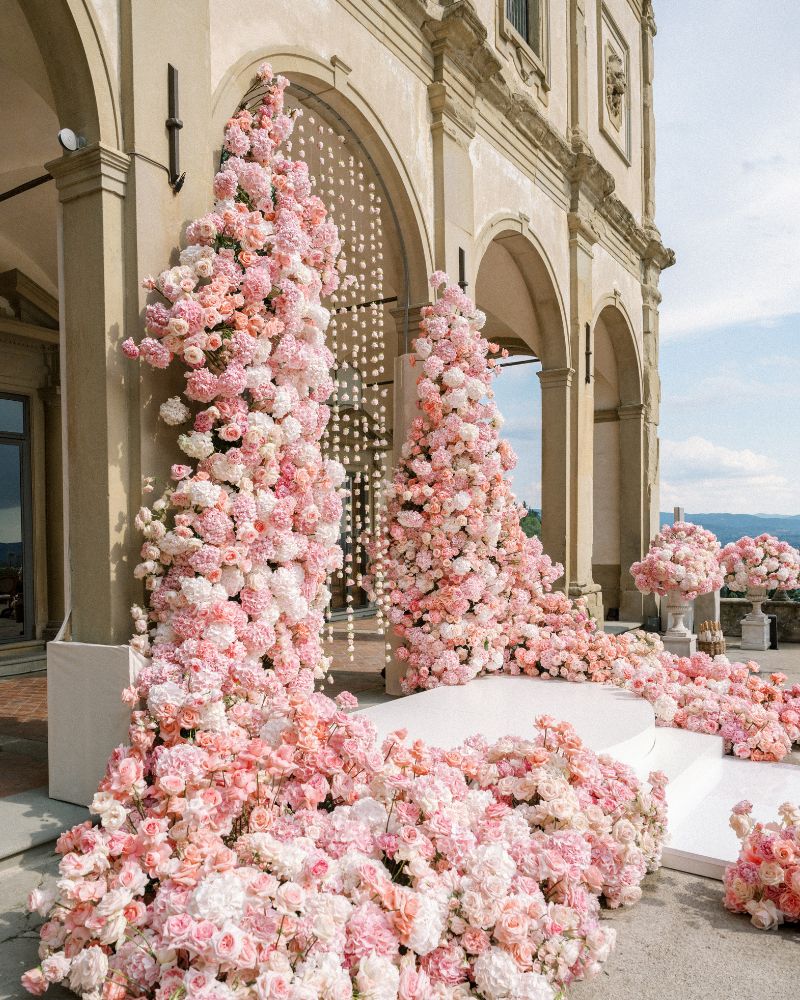
Towering arrangements of blush, pink and ivory flowers frame an elegant outdoor wedding ceremony beneath historic stone arches. Wedding design by Colin Cowie. Photo: Jose Villa
The Opportunity for Wedding Professionals
As couples become more interested in personalized celebrations, the role of wedding professionals continues to evolve.
Planners are increasingly responsible for coordinating experiences rather than simply managing schedules.
Designers must translate personal stories into creative environments.
Venues are challenged to accommodate celebrations that may depart from conventional reception formats.
Photographers and videographers must capture events that place greater emphasis on atmosphere, interaction and storytelling.
And technology is changing how ideas are developed, presented and ultimately produced.
Cowie’s observations suggest that wedding professionals who understand both creativity and hospitality will be particularly well positioned to serve couples seeking something distinctive.
The ability to execute a beautiful event remains important.
But understanding why a particular design matters to a couple may be even more valuable.
The Future of Weddings Is Personal
After four decades in event design, Cowie’s perspective offers an important reminder that wedding success cannot be measured solely by elaborate decorations, extravagant budgets or social media attention.
Technology will continue to influence the planning process. Fashion expectations will evolve. Couples will experiment with new approaches to entertainment, food and design.
But the central purpose of a wedding remains the same: bringing people together to celebrate a relationship.
For couples, that means having the freedom to create a celebration that reflects their personalities rather than following traditions simply because they have always existed.
For wedding professionals, it means understanding that the future of the industry may not be defined by one dominant trend.
Instead, it will be shaped by the ability to create meaningful experiences that are as individual as the couples themselves.
And perhaps that is the most important direction in wedding design: moving beyond what a wedding is supposed to look like and focusing on what the celebration is meant to express.
Colin Cowie is an internationally recognized event designer and founder of Colin Cowie Lifestyle. This article is based on an interview conducted by Wedding Market News in November 2026.