
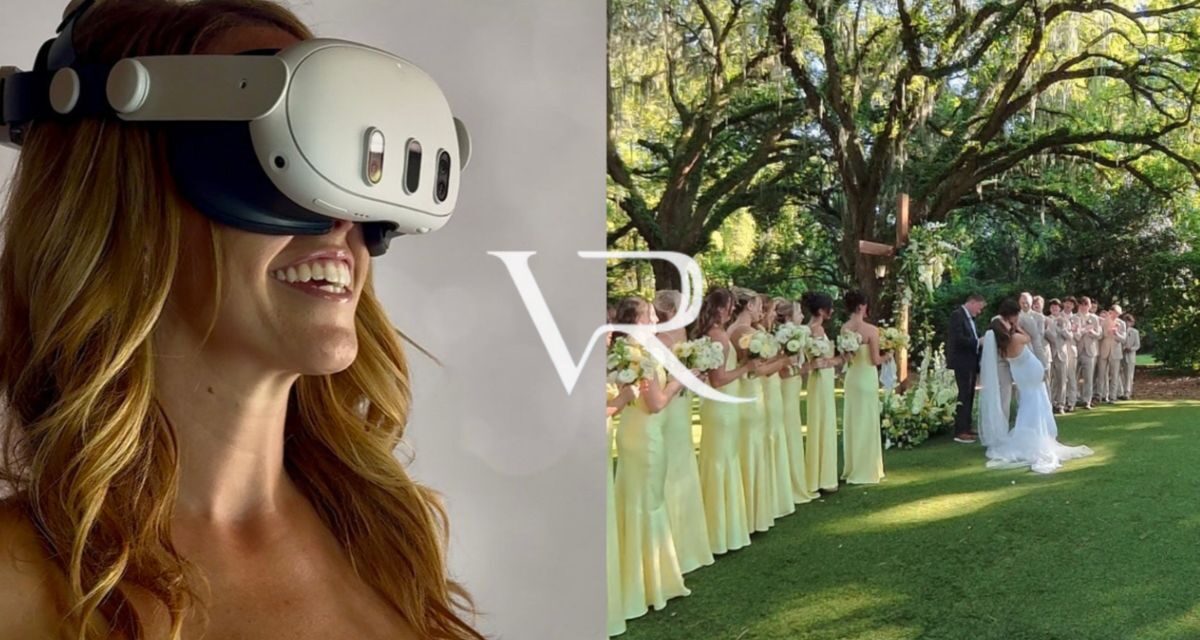
ReVeil Media is building a new model for immersive wedding video that could create an additional revenue stream for videographers, give venues a new way to sell their spaces and help wedding professionals gain exposure through the weddings they create together.
Wedding videography has changed dramatically over the years. Traditional wedding films have been joined by drone footage, vertical social content, same-day edits and other new ways of documenting a wedding.
Could virtual reality be next?
ReVeil Media believes it could.
The wedding technology company uses 360-degree footage to create immersive wedding experiences that couples can revisit through a VR headset or explore on a computer or mobile device.
But ReVeil isn’t building its business solely around filming weddings itself.
The company is developing a model that allows existing wedding videographers to add VR to their own services, while simultaneously partnering with wedding venues to turn real weddings into virtual showrooms for future couples.
For wedding professionals, those two strategies may ultimately be more interesting than the headset itself.
Videographers Don’t Have to Become VR Developers
ReVeil began by filming weddings directly.
But after videos showing couples experiencing their weddings in VR attracted attention online—including exposure from Meta—the founders said inquiries began coming not only from couples, but also from wedding videographers interested in offering the technology themselves.
That helped push ReVeil toward a business-to-business model.
Instead of building a national network of ReVeil camera crews, the company can provide the technology behind the experience while established videographers maintain their relationships with their own clients.
The videographer books the couple and captures compatible 360-degree footage. The files are uploaded to ReVeil, which handles the technology needed to create and deliver the immersive experience.
During an interview with Wedding Market News, ReVeil said it charges participating videographers a flat $495 per wedding.
The videographer determines what to charge the couple.
That distinction is important.
ReVeil isn’t dictating the retail price or taking a percentage of the videographer’s package. A filmmaker could potentially incorporate VR into a premium collection, offer it as an upgrade or develop an entirely separate immersive package.
For established wedding filmmakers, that creates the possibility of adding a new product without having to develop proprietary VR software.
How Much Could a Videographer Charge?
That decision remains with the wedding professional.
During the Wedding Market News interview, ReVeil used the example of a videographer selling the VR experience for $3,000. With ReVeil’s $495 fee, $2,505 would remain with the videographer before accounting for the videographer’s own equipment, labor and other production costs.
That doesn’t mean $3,000 will become the standard price for VR wedding coverage.
Market, clientele, equipment, shooting time and packaging will all influence pricing.
But the model gives videographers something wedding professionals continually look for: a potential new revenue stream that can be added to an existing client relationship.
What Equipment Does a Videographer Need?
ReVeil told Wedding Market News that its platform can work with multiple cameras capable of shooting 360-degree video rather than requiring one proprietary camera system.
The company recommends at least 8K resolution.
That means filmmakers don’t necessarily have to replace the traditional cameras they already use to create cinematic wedding films.
Instead, 360-degree capture becomes another layer of coverage.
And there’s a fundamental difference between the two products.
A traditional wedding film tells the story through shots selected and edited by the filmmaker.
With an immersive experience, the viewer gets to look around.
During the first dance, for example, the couple could potentially turn away from themselves and see the family and friends who were watching them.
Couples Don’t Have to Already Own a VR Headset
One obvious question is whether enough couples own VR headsets to make the service viable.
ReVeil’s founders told Wedding Market News that most couples they have worked with did not already own one.
The experience, however, isn’t limited to a headset.
ReVeil says its 360-degree content can also be viewed on a desktop or mobile device. Users can drag, swipe and scroll to look around the room, while a VR headset provides the fully immersive experience.
That removes one potential barrier to adoption.
ReVeil doesn’t necessarily need widespread VR-headset ownership before videographers can begin offering the service.
ReVeil Is Also Targeting Wedding Venues
While the videographer program creates an opportunity to sell VR as a wedding-media product, ReVeil has identified another use for the technology:
selling the venue itself.
The company has introduced a free VR Showroom program for wedding venues built around a simple idea:
“Show couples the room full. Not empty on a weekday tour.”
Instead of asking couples touring an empty ballroom to imagine tables, lighting, flowers, guests and a packed dance floor, venues can show them an actual wedding that previously took place in that space.
ReVeil says couples can experience those weddings through a VR headset or explore the 360-degree footage from a phone or computer.
For venue sales teams, wedding footage could become more than marketing content.
It becomes part of the venue tour.
The Venue Showroom Costs the Venue $0
ReVeil’s venue business model is particularly interesting.
According to information provided to Wedding Market News, the venue pays nothing for its page, VR Showroom or inquiries. ReVeil says there is no lead charge and it doesn’t take a percentage of the venue’s rates.
Instead, participating venues receive personal referral codes.
The venue introduces interested couples to ReVeil. ReVeil handles the call, quote and booking.
When the first referred couple hires ReVeil and has their wedding filmed, that wedding opens the venue’s VR Showroom. Additional ReVeil weddings filmed at the property can then be added to the showroom.
ReVeil says its direct-to-couple wedding coverage starts at $4,995, including full-day coverage from start to finish with no eight-hour limit.
One Wedding Could Promote the Entire Vendor Team
ReVeil is also looking beyond the relationship between the couple, videographer and venue.
The company says wedding content can remain connected to the professionals who helped create the event.
As ReVeil describes the concept:
“Every post from a wedding carries the whole vendor team.”
That means one strong piece of wedding content could potentially create visibility for more than the professional who posted it.
A florist’s best photograph could also help a couple discover the venue. A couple who falls in love with a venue could potentially discover the planner, florist, photographer, videographer and other professionals responsible for the wedding they’re viewing.
ReVeil summarizes the idea this way:
“One great wedding lifts everyone who made it.”
For wedding professionals, that introduces another dimension to the platform.
Instead of viewing a wedding as isolated portfolio content belonging to individual businesses, it can become a connected portfolio representing the team that created the event.
If ReVeil develops that concept at scale, its platform starts to look like more than a place to experience VR wedding films.
It begins to resemble a visual wedding-professional ecosystem organized around real weddings and the businesses that created them.
The question will be whether that exposure ultimately translates into inquiries and bookings.
What Does This Mean for Traditional Wedding Videography?
VR isn’t necessarily a replacement for a cinematic wedding film.
The products accomplish different things.
A traditional wedding filmmaker controls the storytelling—selecting shots, music, pacing and the moments that become part of the finished film.
An immersive experience gives some of that control back to the viewer.
A couple might watch their edited wedding film to relive the story of their day, while entering the 360-degree experience when they want to explore the environment itself.
That could position VR as an add-on rather than a substitute for traditional wedding videography.
But there’s another potential value to preserving so much of the wedding environment—one that has very little to do with technology.
My Take as a Former Wedding Videographer: VR Will Likely Start in the Luxury Market
As Editor of Wedding Market News and a former wedding videographer, I don’t see virtual reality replacing traditional wedding videography—or immediately becoming something the average couple adds to the wedding budget.
I see it first as a luxury wedding product.
The reality is that not every wedding includes professional videography. While photography remains a priority for many couples, video is still an additional investment that some couples choose not to make.
That makes VR another step up the ladder.
A couple who isn’t planning to hire a traditional wedding videographer probably isn’t the primary customer for immersive wedding coverage.
But a couple who already values wedding film and is willing to make a significant investment in preserving the experience may be a very different customer.
For that couple, 360-degree coverage could become a premium add-on.
I can especially see the appeal at luxury weddings where couples have invested heavily in the entire experience—an extraordinary venue, elaborate floral installations, custom décor, lighting, entertainment and details that may exist for only a matter of hours.
Traditional wedding video can capture that story beautifully.
But 360-degree footage offers something different: the opportunity to return to the environment and look around.
Imagine spending hundreds of thousands of dollars creating an extraordinary wedding environment that disappears at the end of the night. An immersive recording potentially gives the couple another way to preserve not only what happened, but what it felt like to be surrounded by it.
That may be where ReVeil’s opportunity begins.
Rather than asking whether VR will become standard at every wedding, the more relevant question may be:
Will couples who are already investing significantly in wedding videography pay more to preserve their celebration in an immersive format?
If they will, VR doesn’t need to replace traditional wedding videography—or achieve mass-market adoption—to succeed.
It simply needs to become a desirable premium upgrade for couples who already place a high value on wedding film.
A Former Wedding Videographer’s Perspective: Think About the Children
Julie Denney, Editor of Wedding Market News and a former wedding videographer, believes wedding professionals shouldn’t overlook who may eventually watch a couple’s wedding footage the most:
Their children.
“Children will watch their parents’ wedding more than the couple will,” Denney said.
Couples naturally want to watch their wedding video after the celebration. But as the years pass, that footage can take on an entirely different meaning.
It becomes part of a family’s history.
Children can see their parents before they knew them as Mom and Dad. They can see grandparents, relatives and family friends at a different point in their lives.
Years later, that footage may also preserve people who are no longer living.
This is where 360-degree wedding footage presents an interesting possibility.
A traditional wedding video is necessarily shaped by the filmmaker. The videographer decides where the camera points, which reactions are captured and what ultimately appears in the finished film.
With immersive 360-degree footage, future generations could have the ability to explore more of the environment themselves.
Imagine a couple’s child watching their parents’ first dance years later.
Instead of seeing only the angle selected for the traditional wedding film, the child could look around the room and potentially see grandparents watching from a nearby table, relatives celebrating across the room or other moments occurring simultaneously.
In that sense, immersive wedding footage could become more than another wedding-video product.
It could become a digital family time capsule.
For videographers considering whether VR has value beyond being new technology, that may be one of the more compelling possibilities.
The customer purchasing the experience today may not ultimately be the person who values it most decades from now.
Does the Technology Produce Results?
ReVeil has attracted significant online attention, but wedding professionals considering a new product ultimately need more than views.
Videographers need to know whether couples will buy it.
Venues need to know whether it helps convert tours into bookings.
And wedding vendors need to know whether being connected to content from a real wedding generates discovery and inquiries.
As the company expands, Wedding Market News will be interested in seeing measurable results.
How many videographers are actively offering ReVeil?
What percentage of couples offered VR purchase it?
What are videographers successfully charging?
Are VR packages increasing average wedding-video sales?
Does experiencing a real wedding through a venue’s VR Showroom improve tour-to-booking conversion?
And do vendors receive inquiries after couples discover them through another professional’s wedding content?
Those numbers will ultimately help determine whether immersive wedding video becomes a novelty, a luxury upgrade or a meaningful new wedding-media category.
Privacy, Permissions and Usage Rights
The venue showroom and interconnected vendor content also raise questions about permissions.
A wedding captured in 360 degrees potentially includes far more people than a carefully selected portfolio photograph.
If that footage later becomes part of a venue’s sales showroom or content connected to multiple vendor profiles, couples, guests, videographers and venues will need to understand how permissions and usage rights are handled.
That’s particularly important when footage originally created to preserve a couple’s wedding is subsequently used to market businesses or sell future weddings.
What’s Next: 360-Degree Wedding Livestreaming
ReVeil’s founders told Wedding Market News they are also developing 360-degree livestreaming.
The concept could give remote wedding guests a more interactive experience than watching a conventional fixed livestream.
Someone using a VR headset could potentially experience the wedding immersively, while someone without one could navigate the 360-degree view from a computer.
That could create another service opportunity for wedding videographers, particularly for destination weddings or celebrations involving family members who cannot attend.
Could VR Become the Next Wedding Video Upgrade?
Wedding videography has continually changed as new technology becomes accessible.
Drone footage was once unusual.
Vertical wedding content created specifically for social media was once unusual.
Today, both are familiar parts of the wedding-media conversation.
VR may or may not follow the same trajectory.
But ReVeil is approaching adoption differently.
Instead of asking every wedding videographer to become a VR technology expert, it’s giving filmmakers a way to add the product to their existing businesses.
Instead of asking venues to purchase expensive technology before knowing whether couples will respond, ReVeil is offering its VR Showroom at no cost and building it wedding by wedding.
And instead of treating each wedding professional’s work in isolation, ReVeil is exploring a model in which the businesses responsible for creating a wedding remain connected to the content that comes from it.
Perhaps most importantly, the finished product could have a lifespan extending far beyond the newlyweds themselves.
That makes this more than a story about a new way to watch a wedding video.
It’s an experiment in whether one wedding can continue creating value long after the event—as a memory and family time capsule, a new product for the videographer, a sales tool for the venue and a discovery opportunity for the entire vendor team.
If that model works, virtual reality could become much more interesting to the wedding industry than the headset itself.