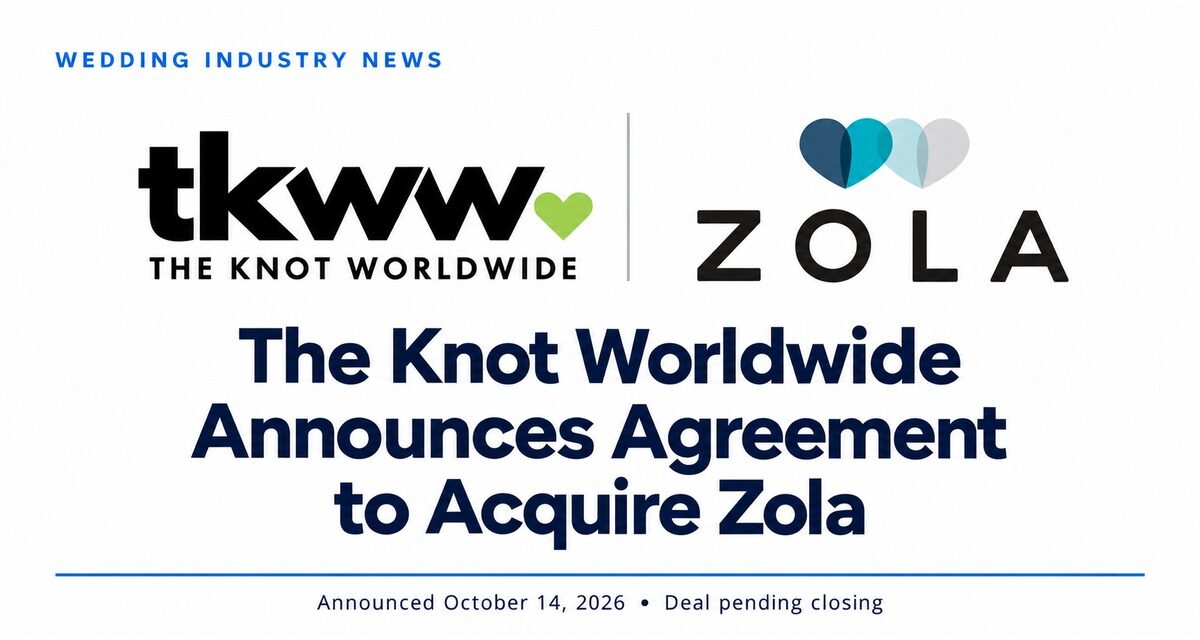
The Knot Worldwide is acquiring Zola, bringing two of the wedding industry’s biggest digital platforms under one company at a time when artificial intelligence, social media and changing consumer behavior are reshaping how couples discover wedding professionals.
The Knot Worldwide announced October 14 that it has entered into a definitive agreement for Zola to join its global portfolio of wedding brands.
The companies say The Knot and Zola will remain separate consumer brands following the transaction. Once completed, the deal will bring The Knot Worldwide’s portfolio to 14 brands across 11 countries.
Financial terms were not disclosed, and the transaction remains subject to customary closing conditions, including any required regulatory clearances.
Together, The Knot Worldwide and Zola reach millions of couples each year and connect them with hundreds of thousands of wedding professionals.
But the significance of this deal could extend well beyond the combination of two major wedding brands.
The acquisition comes as wedding professionals and technology leaders are asking a much bigger question:
Who will control wedding vendor discovery in an AI-driven world?
The Knot Worldwide and Zola Come Together
The Knot Worldwide says the companies plan to combine their strengths in wedding planning, local vendor discovery, personalization, registry and e-commerce.
For wedding professionals, the company says the transaction could eventually create opportunities to reach more engaged couples, improve matching and provide deeper insights designed to turn inquiries into clients.
“Welcoming Zola to our portfolio is an exciting opportunity to help more wedding professionals grow their businesses and create more personalized, connected experiences for couples,” The Knot Worldwide CEO Raina Moskowitz said in announcing the agreement.
The Knot Worldwide has also been investing in AI-powered planning and technology designed to help wedding professionals convert inquiries into bookings. The company describes its broader goal as moving wedding planning beyond simple discovery toward a more connected planning experience.
Zola brings another substantial piece of that ecosystem.
Founded in 2013, Zola began by reinventing the wedding registry before expanding into wedding websites, invitations, planning, vendor discovery and other services.
More than 2 million couples have used Zola, according to the company.
Zola’s Founder Reflects on Where It Started
For Zola co-founder and co-CEO Shan-Lyn Ma, the deal represents a significant milestone in a journey that started more than 13 years ago.
In a LinkedIn post following the announcement, Ma recalled starting Zola with co-founder Nobu Nakaguchi with ideas sketched on actual pieces of paper and placed on the wall of her living room.
The founders spent hours talking with engaged couples about the problems they encountered while planning weddings.
Those conversations eventually helped produce what became one of the wedding industry’s most recognizable technology companies.
Shan-Lyn Ma thanked the millions of couples Zola has served, wedding guests, vendors, employees, investors and members of the company’s leadership team.
And she made clear that the acquisition does not mean she is leaving Zola.
Shan-Lyn Ma said she will continue as Zola’s co-CEO alongside Rachel Jarrett and plans to join The Knot Worldwide’s executive leadership team.
She also suggested that Zola’s original vision remains unfinished: creating a connected place where couples can plan their weddings while feeling supported and confident throughout the process.
The Knot Worldwide acquisition, in her view, provides an opportunity to take that vision further.
A Company Once Valued at About $600 Million
The financial terms of the current transaction have not been disclosed.
However, Zola’s fundraising history provides some perspective on the company’s previous valuation.
Zola raised $100 million in a Series D financing round in 2018 at a reported valuation of approximately $600 million, according to Reuters. The round was led by Comcast Ventures and included NBCUniversal and Goldman Sachs Investment Partners.
That history caught the attention of Wedy founder Rumaiza Ali, who sees the acquisition as part of a larger change in the economics of wedding technology.
Wedy Founder: Follow the Money — and Discovery
Ali argues that the acquisition says as much about the wedding industry’s business model as it does about Zola.
In a LinkedIn post analyzing the deal, she pointed to a fundamental difference between couples and wedding businesses as customers.
Couples generally plan their wedding during a relatively short period of their lives.
Wedding businesses can operate for decades.
And every year, those businesses need another generation of engaged couples to find them.
That makes wedding professionals themselves an extremely valuable recurring customer base for companies operating wedding marketplaces.
Ali notes that Zola initially built much of its business around registry economics, while The Knot’s marketplace model generates revenue from wedding businesses paying to reach engaged couples.
She argues that changing consumer behavior has put pressure on registry economics as more couples already live together before marriage and increasingly request cash funds instead of traditional household gifts.
The acquisition brings Zola into a company where connecting wedding businesses with couples is a central part of the business model.
But Ali believes another change could prove even more important.
AI is becoming a new front door for wedding discovery.
Instead of searching a wedding directory for a photographer, venue, planner or florist, couples can increasingly ask an AI assistant whom they should hire.
Ali points specifically to ChatGPT and Claude as examples of platforms consumers can use to seek recommendations.
Her argument is that AI recommendations can draw upon a business’s broader reputation and information across the web rather than simply determining visibility based on who paid for placement within a particular marketplace.
If that behavior becomes widespread, the implications for wedding marketing could be enormous.
Rachel Jo Silver: The Traditional Marketplace Is Under Pressure
Wedding industry entrepreneur Rachel Jo Silver reached a similar conclusion from another direction.
Silver, founder of Love Stories TV, said she wasn’t surprised to see The Knot Worldwide and Zola consolidate.
Her reasoning: the traditional wedding marketplace model is under pressure.
When The Knot emerged in the 1990s, online wedding marketplaces were disrupting wedding magazines and the Yellow Pages. Couples needed an efficient way to find photographers, venues, planners, florists and other wedding businesses.
Today, there are countless paths to discovery.
Instagram and TikTok can introduce couples to wedding professionals through content. Google can connect couples directly with local businesses. YouTube provides another discovery channel.
And now AI is entering the process.
As Silver put it, TikTok itself has become a search engine for younger consumers — and weddings are inherently visual content.
Silver saw the changing marketplace firsthand with Love Stories TV, which was acquired by David’s Bridal.
She said the company eventually moved away from a traditional marketplace model toward becoming a media business as it became easier for small businesses to build audiences and attract customers directly.
Tools such as Canva and AI have lowered those barriers even further.
Wedding professionals can create websites, produce content and distribute that content across multiple platforms without depending entirely on a wedding-specific marketplace.
Silver’s larger point is particularly important:
Wedding technology companies aren’t just competing against other wedding technology companies anymore.
They are competing with TikTok, AI platforms, Canva and an expanding universe of tools connecting couples and businesses directly.
David’s Bridal Is Taking a Different Approach
Silver also points to David’s Bridal as an example of how competition in wedding technology is expanding beyond traditional wedding websites.
David’s Bridal has been building its “Aisle to Algorithm” strategy around Pearl by David’s, including an AI-powered wedding planning tool and Pearl Connect, its vendor marketplace.
The advantage, Silver argues, isn’t simply technology.
David’s Bridal already has a physical relationship with couples.
A bride walking into a store to shop for a wedding dress creates an opportunity to establish a relationship during an important point in the wedding-planning journey. That relationship can potentially extend into other wedding products, services and vendor recommendations.
That’s a very different competitive advantage from the one held by a digital-only marketplace.
So Where Does AI Fit Into All of This?
The Knot Worldwide clearly recognizes the importance of AI.
The company says its transformation already includes AI-powered planning, new tools for wedding professionals and technology intended to make the planning process more connected.
It also launched a wedding-planning app within ChatGPT earlier this year.
Wedy is making a different bet.
Ali says Wedy is structuring its vendor listings for GEO — generative engine optimization — with the goal of making the information easier for AI models to surface. The company is also using AI agents to help venues and vendors keep information current and move bookings from inquiry toward a signed contract.
As Wedy’s founder, Ali obviously has a business interest in this vision of the industry’s future.
But the larger question she raises extends well beyond Wedy:
If AI assistants become the starting point for wedding planning, what happens to the traditional paid wedding directory?
What This Means for Wedding Professionals
For wedding professionals, the immediate answer is: not much changes today.
The Knot Worldwide says Zola and The Knot will remain distinct consumer brands. WeddingPro has also told its customers that existing storefronts, pricing, account structures and contract terms remain unchanged following the announcement, with advance notice promised before future portfolio changes.
The longer-term implications are much more interesting.
Wedding businesses have spent decades thinking about where they rank on Google, how visible they are on The Knot or WeddingWire and, more recently, whether their Instagram and TikTok content reaches potential customers.
Now another question needs to be added:
Can AI find your business?
A couple might soon ask:
“What are the best barn wedding venues within an hour of Columbus, Ohio for 150 guests?”
Or:
“Find me a documentary-style wedding photographer in Cincinnati with great reviews who charges less than $5,000.”
The businesses that appear in those answers may not necessarily be the businesses purchasing the largest advertising package on a wedding directory.
AI systems can potentially consider information from websites, reviews, articles, social platforms, directories and other sources as they help consumers research their options.
That makes a wedding professional’s overall digital footprint increasingly important.
Websites, reviews, social content, video, local search visibility, authoritative mentions and clear information about services, pricing and location could all become part of the new discovery equation.
The Bigger Story Isn’t Just The Knot Buying Zola
The Knot Worldwide’s acquisition of Zola is significant on its own.
It brings together two of the best-known names in wedding technology and combines The Knot Worldwide’s enormous marketplace reach with Zola’s strengths in e-commerce, registry, personalization and planning.
But the timing may ultimately be just as significant as the acquisition itself.
The wedding industry is entering a period when the very idea of “searching for a wedding vendor” is changing.
For decades, wedding marketplaces helped organize a fragmented industry by bringing thousands of local businesses together in one searchable destination.
Social media began breaking that model apart by allowing wedding professionals to build audiences directly.
Now artificial intelligence could change it again.
The battle may no longer be simply The Knot vs. Zola vs. WeddingWire.
It could become marketplaces vs. social platforms vs. AI assistants — with wedding professionals themselves increasingly able to build direct relationships with couples.
That leaves one question worth watching closely:
Will the next decade of wedding discovery belong to the companies that own the largest wedding marketplaces — or to the businesses that AI determines couples should trust?